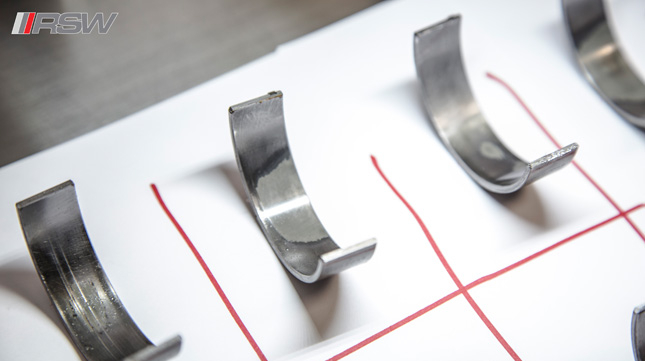
BMW M3 rod bearing failure is one of the most common and costly issues affecting the S65 engine. At Prestige and Performance in Brisbane, we are replacing M3 and S65 rod bearings around 3 times per month, making S65 rod bearing failure one of the most common issues we deal with, so we know this problem better than most. Here’s everything you need to know about why rod bearing failure happens, the warning signs to watch for, and how to prevent serious engine damage.
From our experience, premature rod bearing failure is the number one major failure issue for the S65 engine found in M3’s. The reason for this is that the S65 engine is designed as a sports/performance street engine as close to track ready as legally possible.
When used as designed ie. driven hard, the setup works fine with the thicker 10w-60 oil and tighter than “normal” clearance in the rod bearings. However when subjected to normal roadcar style usage the oil is never really getting up to a decent operating temperature that would allow it to flow into those tight bearings, resulting in premature wear.
This wear eventually results in your bearings either seizing up or spinning which will cause drastic damage to your engine and you will need a completely new engine or a bottom end rebuild. See https://www.m3post.com/forums/showthread.php?t=892838 for all the bearing stats. For a typical performance engine build we would normally be looking at a clearance figure of around .001” per 1” of journal diameter not the .00066” that BMW specifies for the S65.
Which BMW M3 Generations Are Affected? (E90, E92, E93)
The S65 engine covered in this guide was fitted exclusively to the E90 M3 sedan, E92 M3 coupe and E93 M3 convertible, built between 2007 and 2013. If you own or are looking at one of these generations, rod bearing failure is one of the most important things to check before anything else. The issue affects all three body styles equally, since they share the same engine and drivetrain, the only difference is the chassis code stamped on the body.
E90 M3 (Sedan)
The E90 is the four door version of this generation and carries the exact same S65 rod bearing risk as its coupe and convertible siblings. Buyers searching for a family friendly M3 often overlook this model, but the rod bearings need the same 80,000km inspection window regardless of body style.
E92 M3 (Coupe)
The E92 coupe is the most common body style for this generation and the one we see most often for rod bearing replacement. If you’re buying a used E92 M3 without documented proof of rod bearing replacement, treat it as a near certainty that the work is still ahead of you.
E93 M3 (Convertible)
The E93 convertible shares the identical S65 engine and is just as susceptible to rod bearing wear. The added weight of the convertible’s structure doesn’t meaningfully change the risk profile, the engine and oil flow characteristics are what drive this fault, not the body style.
If you’re buying or already own an E90, E92 or E93 M3, book a rod bearing inspection with our Coorparoo or Capalaba workshop before you hit the 80,000km mark. Call (07) 3324 0611 or (07) 3180 1888.
Why BMW M3 Rod Bearing Failure is so Common
The S65 engine was engineered with track-style tolerances, but most M3s spend their lives in normal road conditions. Short trips, gentle driving, and limited high-temperature operation prevent oil from flowing optimally through the tight rod bearing clearances. Over time, this mismatch between design intent and real-world use accelerates bearing wear, even in well-maintained vehicles. This makes S65 rod bearing failure almost inevitable in high-mileage road-driven M3s unless proactive replacement is carried out.
Rod bearing failure symptoms to watch for
It is important to be aware of the signs that your engine rod bearings may be starting to wear or on their way out. It is common that your car will display some or all of these signs.
- Knocking noise: you may notice a knocking noise when you start your car. This is a good sign your rod bearings may need replacing.
- Low oil pressure: You may notice decreased oil pressure when starting your car. Your “check engine oil” light will come on. Do not ignore this even if it only stays on for a few moments after first starting your car.
How to Prevent BMW M3 Rod Bearing Failure
We have found rod bearings start failing around the 80,000km mark. So it’s best to get in and have them replaced well before this point and before you start hearing the symptoms as by then it may be too late. If you have purchased a car over the 80,000km mark and it has no history of having it’s rod bearings replaced we strongly recommend you book in as soon as possible.
One other tip we give which may prolong the life of your rod bearings is to use oil with a thinner viscosity. This allows it to flow into the smaller spaces more easily than a thicker oil, however it won’t prevent the inevitable if damage has already occured. If you’ve purchased a used M3 and have no documented history of S65 rod bearing replacement, we strongly recommend booking an inspection before you reach the 80,000km mark. We also frequently see rod bearing issues flagged during our BMW log book servicing another reason regular servicing matters
If you are buying a used E9X M3, it is worth asking the seller whether the rod bearings have already been replaced and at what mileage, as this has a real bearing on the value and the work ahead. Should you be unsure, we can inspect the engine and advise whether a preventative replacement makes sense for your car. Catching it early is always cheaper than a spun bearing and a bottom end rebuild.
Frequently Asked Questions
What causes rod bearing failure in a BMW M3?
Rod bearing failure in the BMW M3 S65 engine is primarily caused by a mismatch between the engine’s tight factory tolerances and typical road-use driving conditions. The S65 was designed for high-RPM, high-temperature operation. In normal road use, oil never fully reaches operating temperature, meaning it can’t flow properly into the tight bearing clearances, leading to accelerated wear and eventual rod bearing failure.
What are the symptoms of rod bearing failure?
The most common symptoms of rod bearing failure include a knocking or tapping noise on startup, low oil pressure warnings, and a check engine oil light that appears briefly when first starting the car. Any of these signs should be treated as urgent, continued driving with worn rod bearings can result in complete engine failure.
At what mileage does BMW M3 rod bearing failure typically occur?
From our experience servicing BMW M3s in Brisbane, rod bearing failure most commonly begins around the 80,000km mark. We strongly recommend proactive replacement before this point, and especially if you’ve purchased a used M3 with no documented history of rod bearing replacement.
Can rod bearing failure be prevented?
Proactive replacement before symptoms appear is the most reliable prevention. Using a slightly thinner viscosity oil can also help it flow into the tight S65 bearing clearances more effectively. However, if wear has already occurred, oil alone will not prevent failure, inspection and replacement are essential.
How much does BMW M3 rod bearing replacement cost in Brisbane?
Rod bearing replacement cost varies depending on the condition of the engine and whether additional work is required. Contact Prestige and Performance at our Coorparoo or Capalaba locations for a quote, we carry out this repair regularly and can assess your engine quickly.